You have learned to cast spells through studying the mystical forces of nature. See chapter 7 for the rules on spellcasting. The information below details how you use those rules with Druid spells, which appear on the Druid spell list.
Cantrips. You know two cantrips of your choice from the Druid spell list. Druidcraft and Produce Flame are recommended.
Whenever you gain a Druid level, you can replace one of your cantrips with another cantrip of your choice from the Druid spell list.
When you reach Druid levels 4 and 10, you learn another cantrip of your choice from the Druid spell list, as shown in the Cantrips column of the Druid Features table.
Spell Slots. The Druid Features table shows how many spell slots you have to cast your level 1+ spells. You regain all expended slots when you finish a Long Rest.
Prepared Spells of Level 1+. You prepare the list of level 1+ spells that are available for you to cast with this feature. To start, choose four level 1 spells from the Druid spell list. Animal Friendship, Cure Wounds, Faerie Fire, and Thunderwave are recommended.
The number of spells on your list increases as you gain Druid levels, as shown in the Prepared Spells column of the Druid Features table. Whenever that number increases, choose additional spells from the Druid spell list until the number of spells on your list matches the number on the table. The chosen spells must be of a level for which you have spell slots. For example, if you're a level 3 Druid, your list of prepared spells can include six spells of levels 1 and 2 in any combination.
If another Druid feature gives you spells that you always have prepared, those spells don't count against the number of spells you can prepare with this feature, but those spells otherwise count as Druid spells for you.
Changing Your Prepared Spells. Whenever you finish a Long Rest, you can change your list of prepared spells, replacing any of the spells with other Druid spells for which you have spell slots.
Spellcasting Ability. Wisdom is your spellcasting ability for your Druid spells.
Spellcasting Focus. You can use a Druidic Focus as a Spellcasting Focus for your Druid spells.
DruidicClass Feature
You know Druidic, the secret language of Druids. While learning this ancient tongue, you also unlocked the magic of communicating with animals; you always have the Speak with Animals spell prepared.
You can use Druidic to leave hidden messages. You and others who know Druidic automatically spot such a message. Others spot the message's presence with a successful [[/check inv 15]] check but can't decipher it without magic.
Foundry Note
Druidic and Speak with Animals are automatically added during advancement.
Primal OrderClass Feature
You have dedicated yourself to one of the following sacred roles of your choice.
Magician. You know one extra cantrip from the Druid spell list. In addition, your mystical connection to nature gives you a bonus to your Intelligence (Arcana or Nature) checks. The bonus equals your Wisdom modifier (minimum bonus of +1).
Warden. Trained for battle, you gain proficiency with Martial weapons and training with Medium armor.
Foundry Note
You will be prompted to choose during advancement.
Primal Order: MagicianClass Feature
You know one extra cantrip from the Druid spell list. In addition, your mystical connection to nature gives you a bonus to your Intelligence (Arcana or Nature) checks. The bonus equals your Wisdom modifier (minimum bonus of +1, currently [[lookup @abilities.wis.mod]]).
Foundry Note
This feature includes an Active Effect which automates the increase to your known cantrips and the bonus to your Arcane and Nature checks.
You will be prompted for your choice when you select this Species.
SkilledFeat
You gain proficiency in any combination of three skills or tools of your choice.
Repeatable. You can take this feat more than once.
Magic Initiate (Druid)Feat
You gain the following benefits.
Two Cantrips. You learn two cantrips of your choice from the Druid spell list. Intelligence, Wisdom, or Charisma is your spellcasting ability for this feat’s spells (choose when you select this feat).
Level 1 Spell. Choose a level 1 spell from the Druid spell list. You always have that spell prepared. You can cast it once without a spell slot, and you regain the ability to cast it in that way when you finish a Long Rest. You can also cast the spell using any spell slots you have.
Spell Change. Whenever you gain a new level, you can replace one of the spells you chose for this feat with a different spell of the same level from the chosen spell list.
Wild ShapeClass Feature
The power of nature allows you to assume the form of an animal. As a Bonus Action, you shape-shift into a Beast form that you have learned for this feature (see “Known Forms” below). You stay in that form for a number of hours equal to half your Druid level (currently [[lookup @classes.druid.levels]]) or until you use Wild Shape again, have the Incapacitated condition, or die. You can also leave the form early as a Bonus Action.
Number of Uses. You can use Wild Shape twice. You regain one expended use when you finish a Short Rest, and you regain all expended uses when you finish a Long Rest.
You gain additional uses when you reach certain Druid levels, as shown in the Wild Shape column of the Druid Features table.
Current Number of Uses:2
Known Forms. You know four Beast forms for this feature, chosen from among Beast stat blocks that have a maximum Challenge Rating of 1/4 and that lack a Fly Speed. The Rat, Riding Horse, Spider, and Wolf are recommended. Whenever you finish a Long Rest, you can replace one of your known forms with another eligible form.
Wild Shape Automation
This feature includes a Transform activity. When you use it you can select the creature you'd like to Wild Shape into using the Compendium Browser. You can revert the transformation at the top of your sheet by clicking on the kebab menu (three vertical dots) and selecting Restore Transformation.
When you reach certain Druid levels, your number of known forms and the maximum Challenge Rating for those forms increases, as shown in the Beast Shapes table. In addition, starting at level 8, you can adopt a form that has a Fly Speed.
Current Known Forms Limit:4
Current CR Limit:0.25
When choosing known forms, you may look in the Monster Manual or elsewhere for eligible Beasts if the Dungeon Master permits you to do so.
Beast Shapes
Druid Level
Known Forms
Max CR
Fly Speed
2
4
1/4
No
4
6
1/2
No
8
8
1
Yes
Rules While Shape-Shifted. While in a form, you retain your personality, memories, and ability to speak, and the following rules apply:
Temporary Hit Points. When you assume a Wild Shape form, you gain a number of Temporary Hit Points equal to your Druid level.
Game Statistics. Your game statistics are replaced by the Beast's stat block, but you retain your creature type; Hit Points; Hit Point Dice; Intelligence, Wisdom, and Charisma scores; class features; languages; and feats. You also retain your skill and saving throw proficiencies and use your Proficiency Bonus for them, in addition to gaining the proficiencies of the creature. If a skill or saving throw modifier in the Beast's stat block is higher than yours, use the one in the stat block.
No Spellcasting. You can't cast spells, but shape-shifting doesn't break your Concentration or otherwise interfere with a spell you've already cast.
Objects. Your ability to handle objects is determined by the form's limbs rather than your own. In addition, you choose whether your equipment falls in your space, merges into your new form, or is worn by it. Worn equipment functions as normal, but the DM decides whether it's practical for the new form to wear a piece of equipment based on the creature's size and shape. Your equipment doesn't change size or shape to match the new form, and any equipment that the new form can't wear must either fall to the ground or merge with the form. Equipment that merges with the form has no effect while you're in that form.
Wild CompanionClass Feature
You can summon a nature spirit that assumes an animal form to aid you. As a Magic action, you can expend a spell slot or a use of Wild Shape to cast the Find Familiar spell without Material components.
When you cast the spell in this way, the familiar is Fey and disappears when you finish a Long Rest.
Foundry Note
This feature includes a Summon activity which can be used to summon your wild companion. You can choose whether to expend a use of wild shape or a spell slot when activating it.
The summon does not automatically disappear when you finish a Long Rest.
Otherworldly GlamourClass Feature
Whenever you make a Charisma check, you gain a bonus to the check equal to your Wisdom modifier (minimum of +1).
You also gain proficiency in one of these skills of your choice: Deception, Performance, or Persuasion.
Foundry Note
This feature includes an Active Effect which will automatically add the bonus to your Charisma checks.
You will be prompted to choose your proficiency as you level up.
Land's AidClass Feature
As a Magic action, you can expend a use of your Wild Shape and choose a point within 60 feet of yourself. Vitality-giving flowers and life-draining thorns appear for a moment in a 10-foot-radius Sphere centered on that point. Each creature of your choice in the Sphere must make a Constitution saving throw against your spell save DC, taking 2d6 Necrotic damage on a failed save or half as much damage on a successful one. One creature of your choice in that area regains [[/healing @scale.land.lands-aid]]{— Hit Points}.
The damage and healing increase by 1d6 when you reach levels 10 (3d6) and 14 (4d6).
Foundry Note
This feature includes an activity for the saving throw and the healing.
The healing/damage values automatically scale as you level up.
🎭
How to RP with Amergin
No RP guide has been written for this character yet.
🎭 Personality
Traits
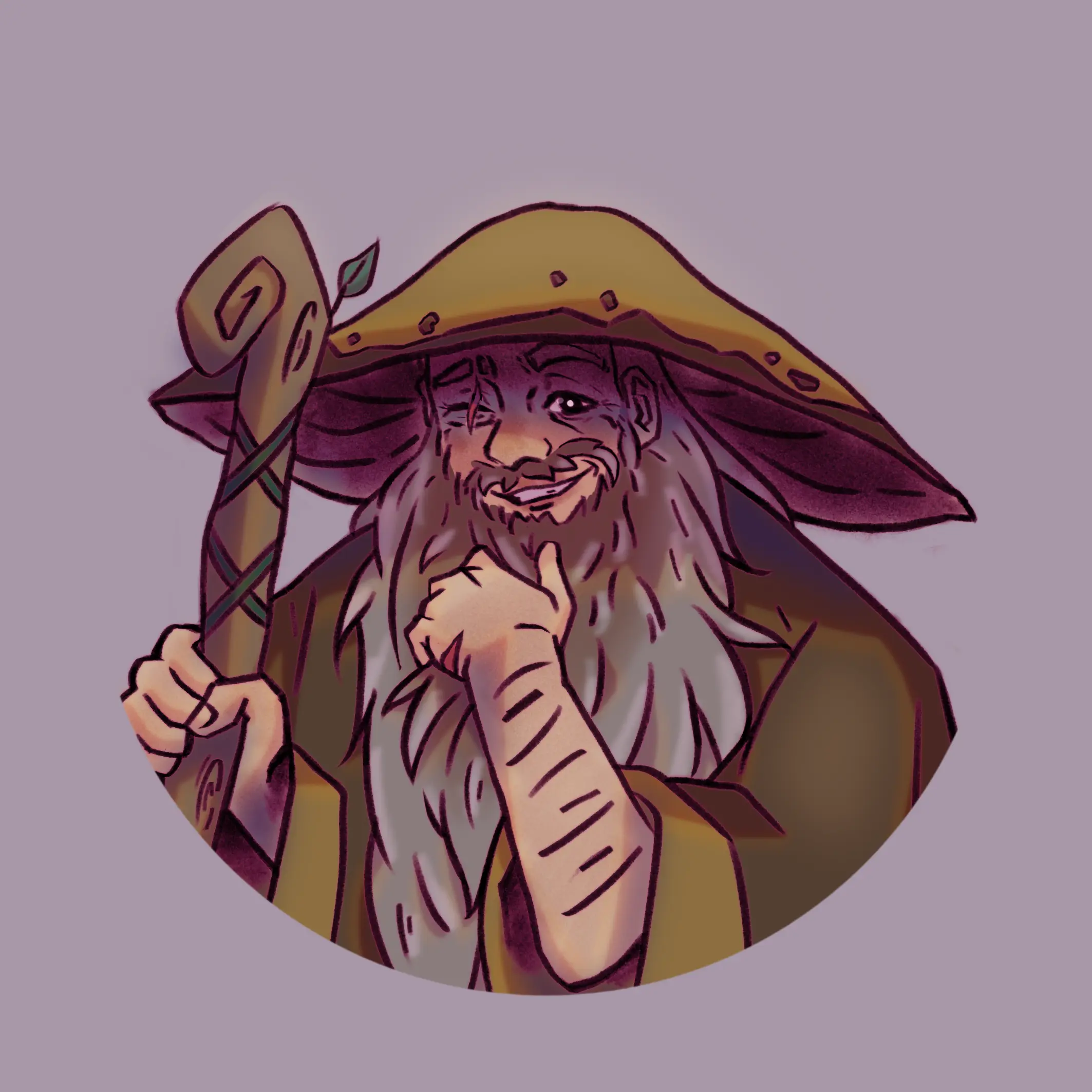
Amergin is an elderly man that enjoys traveling and helping people he passes along the road. Generally a cheerful disposition. Enjoys telling stories, but they don't always seem true.
📅
Events
(1)
Mysterious Past
Amergin's history is shrouded in ambiguity due to his unreliable storytelling and secretive nature. His various tales about his past may contradict each other, leaving his true origins unknown. This mystery adds depth to his character and invites speculation.
🎯
Motivations
(2)
Helping Strangers
Amergin is driven by a genuine desire to assist those he encounters during his travels. This compassion for others, regardless of whether they are strangers, forms the moral foundation of his adventures. His acts of kindness are his way of leaving a positive mark on the world.
Wanderlust
Amergin's primary drive is his love of traveling and exploration across diverse lands and roads. This constant movement keeps him engaged with the world and allows him to encounter new people and experiences. His wanderlust is central to his identity and purpose.
🗺
Locations
(1)
The Road
The endless roads and pathways across the realm serve as Amergin's true home and domain. He knows these routes intimately and uses them to travel between settlements and towns. The road is where he feels most alive and purposeful.
🌀
Traits
(4)
Advanced Age
Amergin is an elderly man whose long life has given him experience and perspective beyond most. His age contrasts with his continued vitality and wandering lifestyle. The wisdom of years combined with his youthful spirit makes him a unique presence.
Cheerful Disposition
Amergin maintains a generally positive and upbeat attitude despite his advanced age. His cheerfulness serves as a beacon to those around him and makes him approachable and trustworthy. This demeanor masks deeper complexities in his character.
Storytelling
Amergin is an accomplished raconteur who loves regaling others with tales from his travels. His stories are entertaining but often contain elements of doubt regarding their truthfulness. This tendency to embellish or fabricate keeps listeners guessing about his true experiences.
Unreliable Narration
Amergin's stories frequently blur the line between fact and fiction, earning him a reputation as an unreliable storyteller. Whether intentional or a product of age and memory, this trait adds intrigue to his character. Companions must decide for themselves what to believe from his tales.